Showing posts with label Hitler. Show all posts

Wednesday, 13 November 2013

Berlin Olympics

The Nazis also used sport as a form of propaganda. The government co-ordinated the sporting bodies under a Reich's sports Fuhrer.  The Hitler youth and DAF organised various activities for the masses. Activities which would help develop fit bodies for that of a soldier or child bearer. 


A poster for the advertising of the games.
In 1936 the government made a greater effort to ensure that sporting propaganda was a success. The Berlin games should of been held in 1916 when the stadium was ready, but instead was put back to 1936 and construction re-started on a Modernist style of stadium. Because Hitler disliked this 'glass box' and insisted on something on a gigantic scale. The existing steel structure was covered in stone to also create a memorial to fallen soldiers to link militarianism with sport; it was out of spirit with the Olympics; Hitler said "he who wishes to live must also fight. And he who will not strive in this world of struggle does not deserve the gift of life."

To Hitler the Olympics were a chance to show physical superiority of the Germans as the master race, there organisational skills and enhance the countries international status. While there was international visitors the level of anti-Semitic propaganda was reduced and the emphasis was on international instead of individual competition. 


 A photograph taken from the Games. 
Max Schmeling's success as a heavyweight boxer, who knocked out Joe Louis in New York in 1936 was used further to demonstrate Nazi supremacy. Football however wasn't Germany's strongest game and wasn't able to match Italy's triumph of winning the world cup. But overall the games meant a rise in Germany's status and they managed to get the English to give the Nazi solute before the 1938 game; giving them a boost. And for those 2 weeks in August 1936; Adolf Hitler's Dictatorship covered its racist, militaristic character; calming down on it anti-Semitic agenda and plans for territorial expansion. Allowing the games to dazzle many foreign spectators and journalists with a peaceful and tolerant Germany illusion. 


Monday, 11 November 2013

The Minister of Enlightenment and Propaganda

As Minister of Enlightenment, Goebbels  had two main tasks:
to ensure nobody in Germany could read or see anything that was hostile or damaging to the Nazi Party.
to ensure that the views of the Nazis were put across in the most persuasive manner possible.
To ensure success, Goebbels had to work with the SS and Gestapo and Albert Speer. The former hunted out those who might produce articles defamatory to the Nazis and Hitler while Speer helped Goebbels with public displays of propaganda.
To ensure that everybody thought in the correct manner, Goebbels set up the Reich Chamber of Commerce in 1933. This organisation dealt with literature, art, music, radio, film, newspapers etc. To produce anything that was in these groups, you had to be a member of the Reich Chamber. The Nazi Party decided if you had the right credentials to be a member. Any person who was not admitted was not allowed to have any work published or performed. Disobedience brought with it severe punishments. As a result of this policy, Nazi Germany introduced a system of censorship. You could only read, see and hear what the Nazis wanted you to read, see and hear. In this way, if you believed what you were told, the Nazi leaders logically assumed that opposition to their rule would be very small and practiced only by those on the very extreme who would be easy to catch.
Hitler came to power in January 1933. By May 1933, the Nazi Party felt sufficiently strong to publicly demonstrate where their beliefs were going when Goebbels organised the first of the infamous book burning episodes. 

Albert Speer


Albert Speer, 1905-81, was a German architect who was, for a part of World War II, Minister of Armaments and War Production for the Third Reich. Speer was Adolf Hitler's chief architect before assuming ministerial office. Speer joined the Nazi Party in 1931, launching him on a political and governmental career which lasted fourteen years.

His architectural skills made him increasingly prominent within the Party and he became a member of Hitler's inner circle. Hitler instructed him to design and construct a number of structures, including the 
Reich Chancellery and the Zeppelinfeld stadium in Nuremberg where Party rallies were held. Speer also made plans to reconstruct Berlin on a grand scale, with huge buildings, wide boulevards, and a reorganized transportation system.

In February 1942, Hitler appointed Speer Minister of Armaments and War Production. Under his leadership, Germany's war production continued to increase despite considerable Allied bombing. After the war, he was tried at Nuremberg and sentenced to 20 years in prison for his role in the Nazi regime, principally for the use of forced labor. He served his full sentence, most of it at Spandau Prison in West Berlin.

Following his release from Spandau in 1966, Speer published two bestselling autobiographical works, Inside the Third Reich and Spandau: The Secret Diaries, detailing his often close personal relationship with Hitler, and providing readers and historians with a unique perspective on the workings of the Nazi regime. He later wrote a third book, Infiltration, about the SS. Speer died of natural causes in 1981 while on a visit to London.

Artichecture

"Architecture is not only the spoken word in stone, it is the expression of the faith and conviction of a community, or else it signifies the power, greatness and fame of a great man or ruler." - Hitler's Cultural address 1937

Nazi architecture was an architectural plan which played a role in the Nazi party's plans to create a cultural and spiritual rebirth in Germany as part of the Third Reich. Nazi buildings were created with community gatherings in mind. Large spaces, where large numbers of people  could come together was first and for most. It was important to Hitler that people be impressed when they came to see his speeches.

The buildings were meant to set a stage for the speaker. The Greatness of these buildings in size and design confirmed the strong Nazi messages. The Nazis believed the atmosphere the buildings created were crucial to how the German public would respond to their speeches. Hitler also started the Thingstätte movement. Where they only used natural materials to build, such as stones, were built on sites thought to be historic. This generally they took after ancient Greek buildings architecturally and the structures were meant to connect Germans to their Aryan ancestry. This was closely linked with the "Blood and Soil" belief. The Nazi party believed that only Germans of Aryan decent should be entitled to German land. Often these buildings were used for Nazi gatherings or celebrations.

Symbolism in German Architecture also played an important role in the style chosen by the Nazi party; German buildings were built for both form and function. The German Art museum serves as a prime example of how Nazi Architecture was symbolic; it was created to house paintings and large numbers of people. It was designed in the style of the Aryans, giving it a cultural and temple like feeling. It contained paintings specifically praised by Hitler and the Nazis and so became an experience similar to that of worship in a church. Nazi Architecture began to take on two styles one mimicked after the neo-classicism period and the other similar to that of Volkisch. 

1. Neo Classicism means; the revival of a classical style or treatment in art, literature, architecture, or music. And most buildings were elaborate, symmetrical, imposing, and timeless works; while keeping to the traditional theme. 

2. VÖLKISCH means: (of a person or ideology) populist or nationalist, and typically racist. the volkisch style was mainly used in the rural towns. Housing was created for many Germans in this traditional style. And although the buildings appeared in traditional older settings many of them were used for modern businesses. Nazi buildings were not meant to be inventive or spectacular, rather they were intended to be traditional and connect the German population with their Aryan roots which was the aim behind architecture propaganda. The Nazi Party strictly forbid any modern building to be built; in their aim to return to the traditional roots.

Albert Speer was a major proponent for the neo classicism style. He encouraged the use of traditional materials and assured that years later even when the buildings were neglected, they would look profound and powerful. Hitler believed that granite and marble were the only materials that were worth using because of their grandeur and structure that would last over the third Reich. While some historians believe that it was an economic necessity masked by symbolism. The articeture was meant to symbolise German values; celebrate labour, motherhood and the Aryan race/ way of life and throughout the buildings the sculptures and tiled mosaics also represented these celebrations. 

Himmilar once spoke on architecture. He said: 

"When people are silent, stones speak. By means of the stone, great epochs speak to the present so that fellow citizens; are able to uplift themselves through the beauty of self-made buildings. Proud and self-assured, they should be able to look upon these works erected by their own community." 

and…

"Buildings are always erected by people. People are children of their blood, are members or their race. As blood speaks, so the people build." 

this shows that Nazi Architecture was so much more than just building design. It was just as much propaganda as the cartoons of Hitler handing out food, or with angel like wings. It was designed with a goal in mind. It was meant to create a place for mass gatherings, represent the importance of Hitler and the traditional movement and impart values of Community in the people of Germany.

Cultural propaganda; Paintings...

Hitler was very interested in paintings and in 1828 Alfred Rosenberg set up the combat league for German culture, once in power Hitler began to remove any work he say was ‘degenerate’ or corrupt. To make wake for ‘healthy’ Aryan art, this portrayed the Nazi ideology and message. Others had wider artistic taste but in 1936 Hitler’s views were imposed.


Modern, abstract, reflective art that had become popular in the Weimar Republic was replaced by clear visuals that ordinary Germans could understand and could be inspired by.  Nazi art was to be clear, direct and heroic. This meant people were not drawn as real individuals but instead as heroic idealisations (the healthy peasant, the brave warrior, the productive woman for examples). All the while Hitler was portrayed as the ‘wise, imperious leader’.

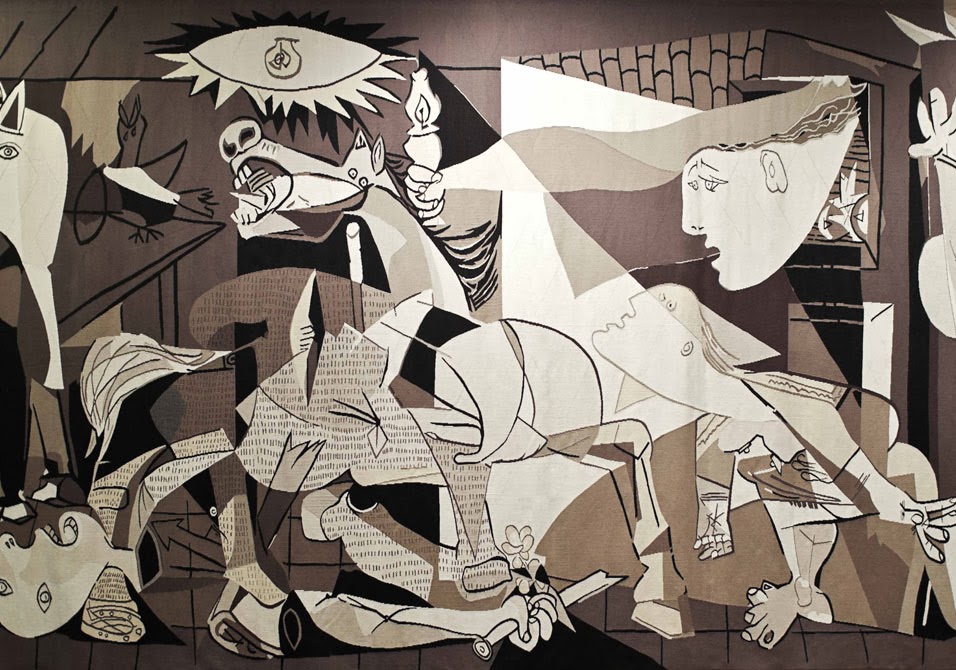
example of abstract work of the time
that was seen as degenerate and disturbing.
Landscapes, revealing sources of the Volk and rural life, predominated, followed by nude women to display biological purity. Even though they were superficially realistic compared to the much hated abstract art, it didn’t reflect the real world so much as the Nazi ideology and myths.

Hitler saw that art should be of the masses; in both terms of reflecting popularity and to reach mass audiences. This therefore made this form of propaganda effective; as the state had control over what was produced and how it was spread through-out Germany. All working artists had to become members of the ‘Reich Culture Chamber’ and the state could remove licences to teach, exhibit or paint by issuing a ‘Malverbot’.
There were lots of well-attended local and national exhibitions throughout this period, in 1935 over 120 exhibitions were held in factories and in 1941 there were over 1000 art exhibitions overall.  Many paintings were reproduced full scale or for postcards, stamps, in journals or newspapers. One magazine had over 50,000 prints ran over its course.

Lehmann-Haupt said that everyone was ‘continuously exposed to some form of officially sponsored art activity’ but looking at it from an artistic viewpoint it shows how German art degenerated under the Third Reich into masses of stereotypical images. This was because many of the greatest artists had left the country. Or went into internal exile meaning they stayed in Germany but stopped working as an artist.


Art propaganda took several forms...

Sculpture;

Sculptures were mire immediately accessible to people through the fact many had been placed inform of public buildings. And by 1934 it was decreed that all new public buildings should be embellished by statues which conveyed the Nazi message. Many showed the typical stereotype of the Nazi race and virtues with the ‘perfect’ exterior. A series of sculptures were of muscled men parading; these were in-front of Nazi buildings to reflect on the biologically pure, vigorous Aryan race.

Hitler’s favourite sculptures were Arno Breker and Josef Thorsk and so were given great studios to produce masses of heroic German figures with dominating animals attached, such as the eagle.   
the eagle representing power, protection and
domination. 

muscle man, represent strong perfection of the master race!


statues were placed outside of public
buildings so people saw them a lot.