Showing posts with label propganda. Show all posts

Monday, 11 November 2013

The Minister of Enlightenment and Propaganda

As Minister of Enlightenment, Goebbels  had two main tasks:
to ensure nobody in Germany could read or see anything that was hostile or damaging to the Nazi Party.
to ensure that the views of the Nazis were put across in the most persuasive manner possible.
To ensure success, Goebbels had to work with the SS and Gestapo and Albert Speer. The former hunted out those who might produce articles defamatory to the Nazis and Hitler while Speer helped Goebbels with public displays of propaganda.
To ensure that everybody thought in the correct manner, Goebbels set up the Reich Chamber of Commerce in 1933. This organisation dealt with literature, art, music, radio, film, newspapers etc. To produce anything that was in these groups, you had to be a member of the Reich Chamber. The Nazi Party decided if you had the right credentials to be a member. Any person who was not admitted was not allowed to have any work published or performed. Disobedience brought with it severe punishments. As a result of this policy, Nazi Germany introduced a system of censorship. You could only read, see and hear what the Nazis wanted you to read, see and hear. In this way, if you believed what you were told, the Nazi leaders logically assumed that opposition to their rule would be very small and practiced only by those on the very extreme who would be easy to catch.
Hitler came to power in January 1933. By May 1933, the Nazi Party felt sufficiently strong to publicly demonstrate where their beliefs were going when Goebbels organised the first of the infamous book burning episodes. 

Cultural propaganda; Paintings...

Hitler was very interested in paintings and in 1828 Alfred Rosenberg set up the combat league for German culture, once in power Hitler began to remove any work he say was ‘degenerate’ or corrupt. To make wake for ‘healthy’ Aryan art, this portrayed the Nazi ideology and message. Others had wider artistic taste but in 1936 Hitler’s views were imposed.


Modern, abstract, reflective art that had become popular in the Weimar Republic was replaced by clear visuals that ordinary Germans could understand and could be inspired by.  Nazi art was to be clear, direct and heroic. This meant people were not drawn as real individuals but instead as heroic idealisations (the healthy peasant, the brave warrior, the productive woman for examples). All the while Hitler was portrayed as the ‘wise, imperious leader’.

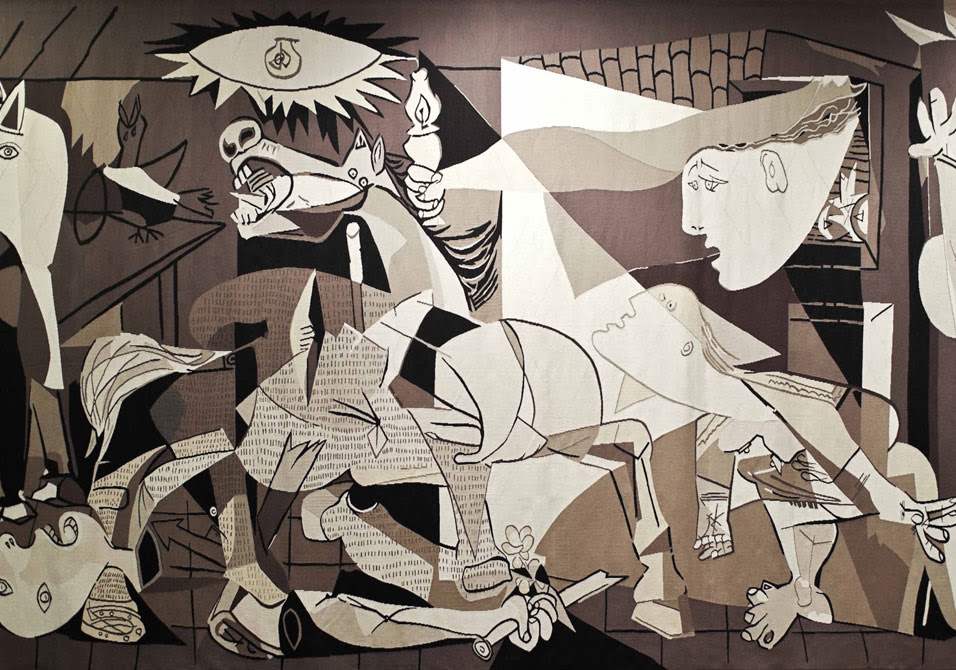
example of abstract work of the time
that was seen as degenerate and disturbing.
Landscapes, revealing sources of the Volk and rural life, predominated, followed by nude women to display biological purity. Even though they were superficially realistic compared to the much hated abstract art, it didn’t reflect the real world so much as the Nazi ideology and myths.

Hitler saw that art should be of the masses; in both terms of reflecting popularity and to reach mass audiences. This therefore made this form of propaganda effective; as the state had control over what was produced and how it was spread through-out Germany. All working artists had to become members of the ‘Reich Culture Chamber’ and the state could remove licences to teach, exhibit or paint by issuing a ‘Malverbot’.
There were lots of well-attended local and national exhibitions throughout this period, in 1935 over 120 exhibitions were held in factories and in 1941 there were over 1000 art exhibitions overall.  Many paintings were reproduced full scale or for postcards, stamps, in journals or newspapers. One magazine had over 50,000 prints ran over its course.

Lehmann-Haupt said that everyone was ‘continuously exposed to some form of officially sponsored art activity’ but looking at it from an artistic viewpoint it shows how German art degenerated under the Third Reich into masses of stereotypical images. This was because many of the greatest artists had left the country. Or went into internal exile meaning they stayed in Germany but stopped working as an artist.


Sunday, 10 November 2013

Parade - Nuremberg Rally

 The Nuremberg Rally was the annual rally of the Nazi Party in Germany, held from 1923 to 1938. They were large Nazi propaganda events. These events were held at the Nazi party rally grounds in Nuremberg from 1933 to 1938 and are usually referred to in English as the Nuremberg Rallies. The Nazi Party rallies took place in 1923 in Munich, 1926 in Weimar, 1927 on they took place in only Nuremberg. The Party selected Nuremberg for pragmatic reasons: it lay in the center of the German Reich and the local Luitpoldhain was well suited as a venue. In addition, the Nazis could rely on the well-organized local branch of the party in Franconia, then led by Gauleiter Julius Streicher. The Nuremberg police were sympathetic to the event.

Films.

Films was seen more as a means of relaxation than directly for explicit propaganda purposes. 

The number of flimgoers quadrupled between 1933 and 1942. The state over time increasing got control over both film companies and the content of films. The government left 4 major film companies to stay private because they didn't want to effect or harm the amount of export sales. However, the RMVP gradually brought up shares, and increasingly financed films, so indrectly comapnies became state owned. In 1942 all were nationalised under Ufi (Ufa Film GmbH)

Several American films were banned in Germany. 

Goebbels personally looked over each film broadcasting in Germany to see it was fit for German citizens to watch. For example if it was 'politically and artistically valuable', 'culturally valuable', a 'film of the nation', 'valuable for youth' - and given money accordingly. During the Nazi regime over one thousand feature films were produced. With one-sixth bein overtly propagandist. 

Leni Riefenstahl a producer was in charge of get detailed recording rallies and festivals, to tell/explain to people what's happening. Her most famous films were 'Triumph of the Will' about the Nuremberg Rally and 'Olympia' about the 1936 Olympic Games in Berlin.

Films were probably more effective in keeping support for the regime than in indoctrinating people with Nazism. The need for entertainment took priority. 


Press.

The Nazi's had three main methods of control over the press:

Firstly, it controlled all of these involvements in press - journalist, editors, publishers - through compulsory membership of co-ordinating bodies. The Reich Press Chamber included the Reich Assoication of the German Press which kept a reigister of acceptable editors and journalists. A law created in October 1933 made editors respsonible for infrigements of government directives. Thus meaning that anything published against the government were removed, so everything publised in newspapers about the government were positive. 

Secondly, the RMVP controlled the content of the press through the state-controlled Press Agaency which provided roughly half of te content of the newspapers. The RMVP helded daily press conferences and issued detailed directives on content, including the length and position of articles. 

Lastly, control was exercised by by extending Nazi ownership of the press. The Nazi Party's publishing house, Ether Verlag, gradually took over, directly or indrectly, most of the press. Thus Nazi ownership of the media grew from 5% (of circulation) in 1933 to 69% in 1939 and to 82% in 1944. 


Meetings and Rallies!

Meetings and Rallies were one of the most effective ways of gaining support. Supportivers commitment would have strengthen attending rallies. They also won over bystanders. Rallies also even made non-participants fell they wanted to become art of such an impressive movement. Rallies were carefully organised.

Goebbels described how rallies transformed a person 'from a little worm into a part of a large dragon!' Speer specialised in choreographing the displays etc. by using architecture of light, to create an effect similar to today's pop concerts!

The combination of uniforms, disciplined mass movements, stirring music, striking flags and symbols, often at night, created a powerful feeling of wishing to belong. Then came the adress by Hitler, the master of manipulating mass emotions. 


A few pictures of a typical Nazi rally!! 

From these pictures you can see the amount of people that would of have been attending. HUGE!

Saturday, 9 November 2013

Theatre in Nazi Germany - Propaganda

The experimentation in drama was abruptly ended in the Third Reich. Many playwrights such as Bertolt Brecht and Ernst Toller emigrated with others being banned from making productions. Drama now concentrated on historical drama, light entertainment and ‘blood and soil’ stories. Drama was brought to the people in subsidised theatres run by Strength through Joy, and by touring companies. A new form of drama called Thingspielen (literally, assembly) was developed. A combination of pageant circus, it glorified the pagan past and was performed in specially constructed outdoor amphitheatres.
About 4000 people connected to theatre fled from the country because of the dictatorship. Jewish actors were forced to take an early retirement or be exiled.

Thursday, 7 November 2013

Examples of Poster Propaganda...

Hitler playing the role of God, planting the seeds for a
greater Germany.


The one leader..
suggestion that the jews are as sbad as communists and very much controlled the money; as they got rich while others got poor.


Wednesday, 6 November 2013

Advantages of Posters...

Posters were a backbone of the Nazi propaganda effort, aimed both at Germany itself and occupied territories. 

It's advantages included;

  • The visual effect; as by being striking,  it would reach the viewer easily and catch their attention.
  • Posters were also, unlike other forms of propaganda such as film and other media sources, difficult to avoid. This was because forms of posters were put up everywhere.
  • Imagery frequently drew on heroic realism; for example the Nazi youth and the SS were depicted monumentally, with lighting posed to portray grandeur.. this therefore influenced others to want to get involved and be seen in the same way.


Hans Schweitzer produced many Nazi propaganda posters.

What is propaganda?

Propaganda is some form of information that is either biased or to a misleading nature; to promote or persuade people to do something, without realising. 
Normally to promote a political cause / point of view.