Hitler was very interested in paintings and in 1828 Alfred
Rosenberg set up the combat league for German culture, once in power Hitler
began to remove any work he say was ‘degenerate’ or corrupt. To make wake for ‘healthy’
Aryan art, this portrayed the Nazi ideology and message. Others had wider
artistic taste but in 1936 Hitler’s views were imposed.
Modern, abstract, reflective art that had become popular in
the Weimar Republic was replaced by clear visuals that ordinary Germans could
understand and could be inspired by.
Nazi art was to be clear, direct and heroic. This meant people were not
drawn as real individuals but instead as heroic idealisations (the healthy
peasant, the brave warrior, the productive woman for examples). All the while
Hitler was portrayed as the ‘wise, imperious leader’.
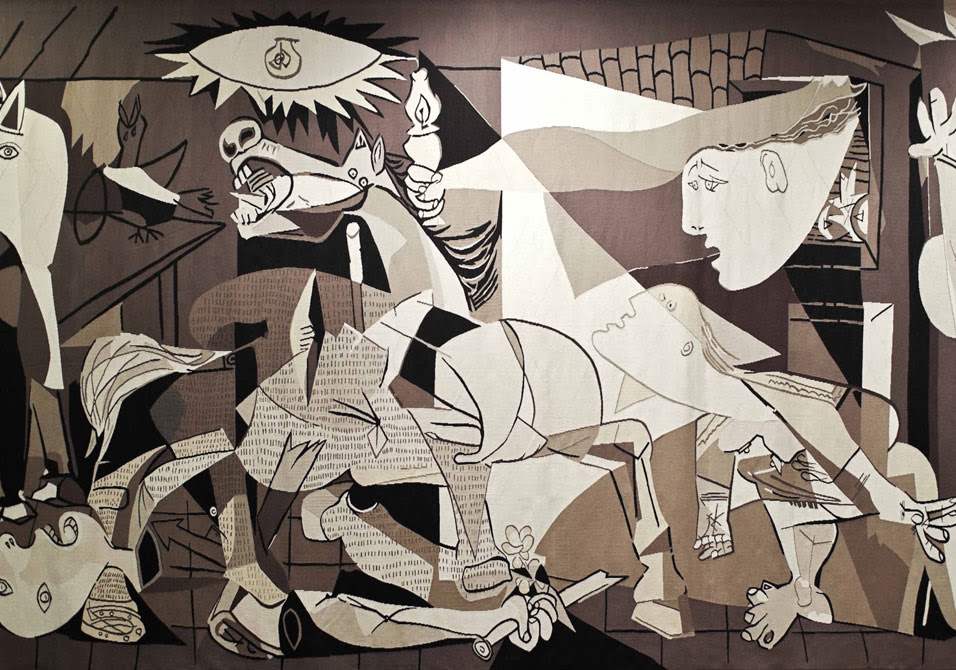
 |
example of abstract work of the time
that was seen as degenerate and disturbing. |
Landscapes, revealing sources of the Volk and rural life,
predominated, followed by nude women to display biological purity. Even though
they were superficially realistic compared to the much hated abstract art, it didn’t
reflect the real world so much as the Nazi ideology and myths.
Hitler saw that art should be of the masses; in both terms
of reflecting popularity and to reach mass audiences. This therefore made this
form of propaganda effective; as the state had control over what was produced
and how it was spread through-out Germany. All working artists had to become members
of the ‘Reich Culture Chamber’ and the state could remove licences to teach, exhibit
or paint by issuing a ‘Malverbot’.
 There were lots of well-attended local and national
exhibitions throughout this period, in 1935 over 120 exhibitions were held in
factories and in 1941 there were over 1000 art exhibitions overall. Many paintings were reproduced full scale or
for postcards, stamps, in journals or newspapers. One magazine had over 50,000
prints ran over its course.
There were lots of well-attended local and national
exhibitions throughout this period, in 1935 over 120 exhibitions were held in
factories and in 1941 there were over 1000 art exhibitions overall. Many paintings were reproduced full scale or
for postcards, stamps, in journals or newspapers. One magazine had over 50,000
prints ran over its course.
Lehmann-Haupt said that everyone was ‘continuously exposed
to some form of officially sponsored art activity’ but looking at it from an
artistic viewpoint it shows how German art degenerated under the Third Reich
into masses of stereotypical images. This was because many of the greatest
artists had left the country. Or went into internal exile meaning they stayed
in Germany but stopped working as an artist.